
Raveen Wijewickrama
Vehicle & Sensing Systems Development Lead | Researcher
The University of Texas at San Antonio
A researcher in the department of computer science at the University of Texas at San Antonio, specializing in mobile sensing, micromobility, and privacy. I also stress bake!
Interests
- Mobile Sensing
- Micromobility
- Wearable Systems
- Human-Computer Interactions
- AI-Generated Content
- Privacy
Education
-
PhD in Computer Science, 2024
The University of Texas at San Antonio
-
MS in Computer Science, 2017
Wichita State University, Kansas
-
BS in Computer Science, 2015
Asia Pacific Institute of Information Technology (APIIT) Sri Lanka
Skills
Python
Java
Android
HTML
JavaScript
Node.js
SQL
Data Science
Pandas, Numpy, Scipy, Scikit-learn, Pytorch, Tensorflow
Operating Systems
Windows, Linux, Android
Networking
TCP/IP, DNS, DHCP, VPN
Web
Apache, Nginx, Caddy
Most Recent Experience
Vehicle & Sensing Systems Development Lead
Vehicle & Sensing Systems Development Lead
Research Assistant
Graduate Teaching Assistant
Engineering Intern
Recent Projects
.js-id-scooters
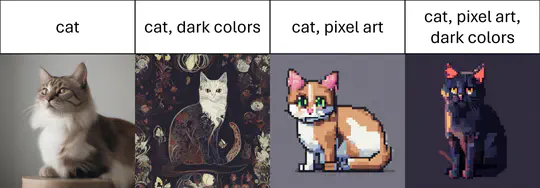
The emerging field of AI-generated art has witnessed the rise of prompt marketplaces, where creators can purchase, sell, or share prompts for generating unique artworks. These marketplaces often assert ownership over prompts, claiming them as intellectual property. This paper investigates whether concealed prompts sold on prompt marketplaces can be considered as secure intellectual property, given that humans and AI tools may be able to approximately infer the prompts based on publicly advertised sample images accompanying each prompt on sale. Specifically, our survey aims to assess (i) how accurately can humans infer the original prompt solely by examining an AI-generated image, with the goal of generating images similar to the original image, and (ii) the possibility of improving upon individual human and AI prompt inferences by crafting human-AI combined prompts with the help of a large language model. Although previous research has explored the use of AI and machine learning to infer (and also protect against) prompt inference, we are the first to include humans in the loop. Our findings indicate that while humans and human-AI collaborations can infer prompts and generate similar images with high accuracy, they are not as successful as using the original prompt.
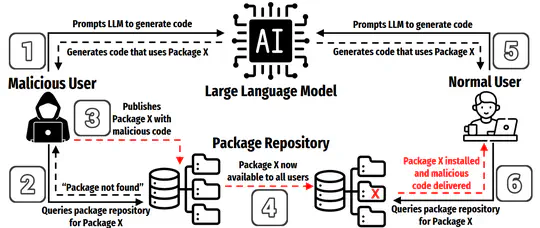
The rise of code-generating Large Language Models (LLMs) has introduced a new threat to the software supply chain: package hallucinations. These occur when LLMs generate non-existent or incorrect package names, leading to a novel form of package confusion attack. This paper presents a comprehensive study of package hallucinations across Python and JavaScript, using 576,000 code samples generated by 16 LLMs with varied prompts. Our findings reveal that hallucination rates average 5.2% for commercial models and 21.7% for open-source models, resulting in over 205,000 unique hallucinated packages. We analyze the factors contributing to these hallucinations and propose mitigation strategies that significantly reduce their occurrence without sacrificing code quality. Our results highlight package hallucinations as a persistent and systemic challenge in LLM-based code generation, warranting urgent attention from the research and developer communities.
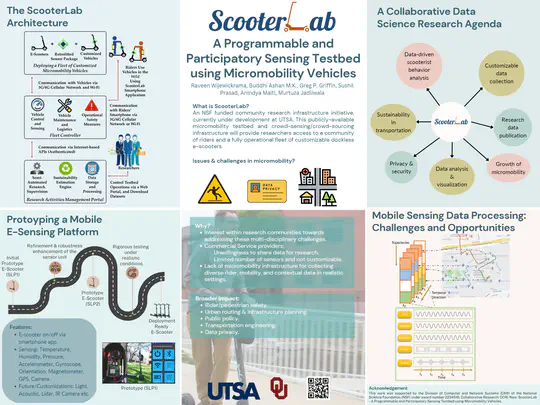
ScooterLab is a National Science Foundation (NSF) funded community research infrastructure initiative at the University of Texas at San Antonio (UTSA). This publicly-available micromobility testbed and crowd-sensing/crowd-sourcing infrastructure will provide researchers access to a community of riders and a fully operational fleet of highly customizable dockless e-scooters. The research team is prototyping infrastructure to be easily retrofitted with state-of-the-art sensors in partnership with collaborators, enabling real-time collection of fine-grained research data from micromobility rides.
Gallery









Recent Publications
Quickly discover relevant content by filtering publications.
(2025).
ScooterLab: A Programmable and Participatory Sensing Research Testbed using Micromobility Vehicles.
In PERCOM.
(2025).
We have a package for you! A comprehensive analysis of package hallucinations by code generating llms.
In USENIX.
(2024).
MirageFlow: A New Bandwidth Inflation Attack on Tor.
In NDSS.
(2023).
SkinSense: Efficient Vibration-based Communications Over Human Body Using Motion Sensors.
Internet of Things, 23(1).